Quantum Computers Simulate Light Propagation
New quantum algorithm developed by in collaboration between Gärttner group and Falk Eilenberger (Fraunhofer IOF)
Light propagation through a lens, simulated by a quantum circuit
Image: Prof. Dr. Martin Gärttner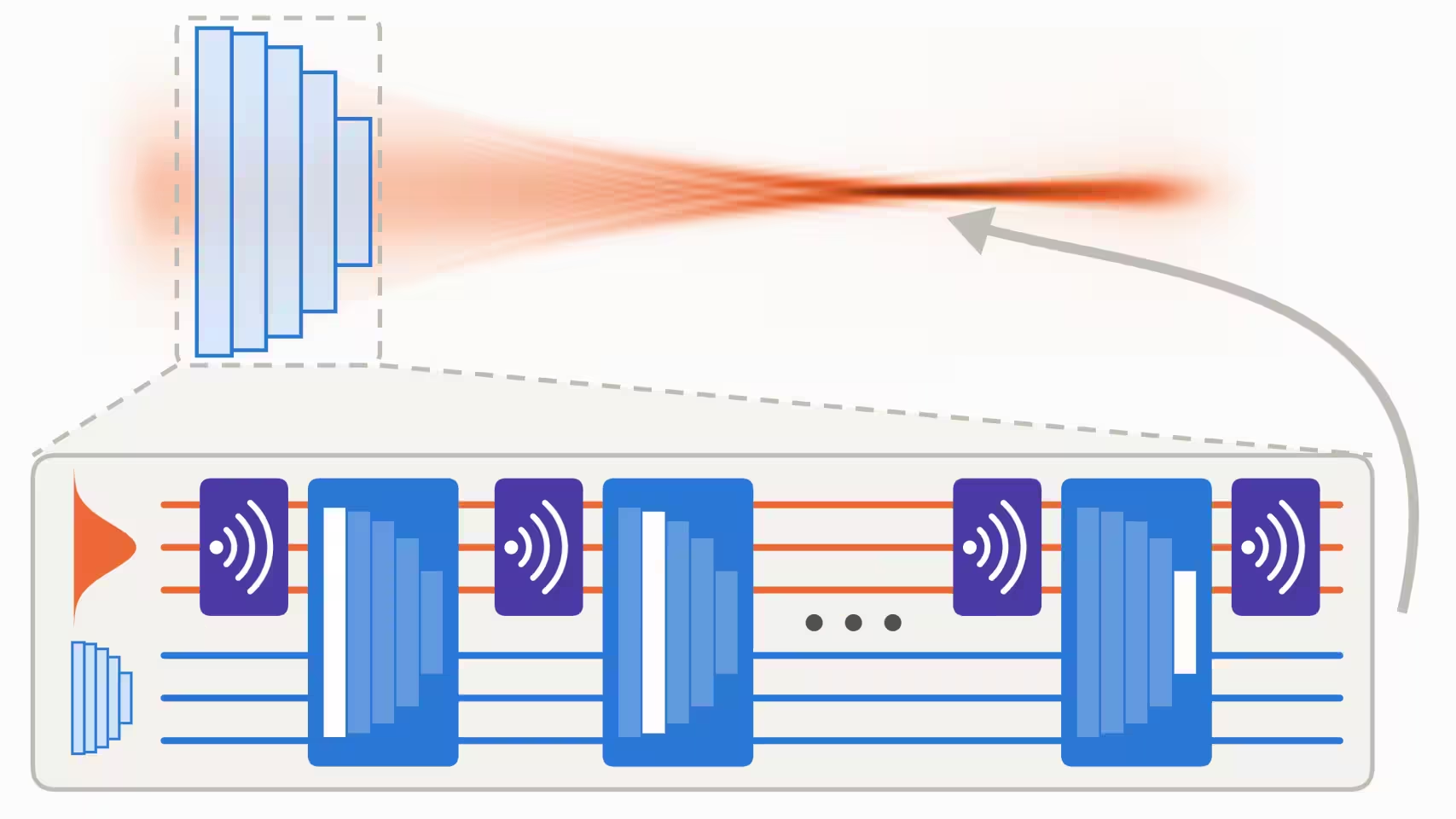
Published:
Quantum simulation of wave optics in weakly inhomogeneous media using block encoding
We have developed a quantum algorithm that simulates how a beam of light travels through lenses and other optical materials, giving engineers a new tool for designing optical devices. Lasers, camera lenses, and fiber-optic networks are designed using computer simulations, but modeling light in complex structures demands enormous memory and computing power. Our work builds on a known fact: light moving through a material obeys the same equation as a quantum particle, so a quantum computer can mimic it naturally. What is new is how we include the material in the simulation. We split the beam's path into small time steps; in each step, the light spreads out as it would in empty space, then is delayed by the material. A flexible new quantum operation applies these delays, and different lenses are modeled simply by tuning its parameters. Because quantum computers store information extremely compactly, the algorithm needs far less memory than conventional simulations. Simulating a beam focused by a thick lens, we reproduced the focal spot and the blurring known as spherical aberration. The method also directly estimates quantities engineers care about, such as how efficiently light enters an optical fiber.
Link to paper: https://doi.org/10.1103/snzq-fp39External link